Blocked toilet London problems are difficult to ignore. The water may drain slowly, the bowl may start filling higher than normal, or the toilet may stop flushing altogether.
In many London homes, a minor blockage can be cleared with the right method and a little patience. But repeatedly flushing the toilet, using the wrong chemicals or pushing an obstruction further into the pipe can make the situation considerably worse.
The key is knowing what you can safely try yourself and when it is time to call a professional plumber.
This guide explains the most common causes of blocked toilets, the safest DIY methods to try first, what you should avoid, and when a blockage could indicate a more serious drainage problem.
Quick answer: what should you do with a blocked toilet?
If your toilet is blocked but the water level is not dangerously high, start with simple mechanical methods rather than harsh chemicals.
The usual order is:
- Stop flushing.
- Allow the water level to settle.
- Use a suitable toilet plunger.
- Try warm water and washing-up liquid if appropriate.
- Check whether the blockage clears.
- Test the toilet carefully.
- Call a plumber if the blockage remains or keeps returning.
If the toilet is overflowing, sewage is backing up, or several drains in the property are affected, treat the situation as more urgent.
Blocked Toilet London: Common Causes
Toilets are designed to carry human waste and toilet paper through the drainage system. Problems occur when something restricts that passage.
Common causes include:
- Too much toilet paper
- Excessive waste
- Wet wipes
- Sanitary products
- Paper towels
- Children’s toys or other objects
- Excessive cleaning products
- Limescale and mineral deposits
- Problems further along the drainage pipe
- Tree roots or damaged external drainage
In some cases, the blockage is entirely inside the toilet trap.
In others, the toilet is simply the first place where a larger drainage problem becomes visible.
How to tell how serious the blockage is
Before trying to fix anything, look at what the rest of the plumbing system is doing.
The toilet is blocked but everything else works normally
This usually suggests a local blockage in the toilet or its immediate waste pipe.
A plunger may be enough to solve it.
The toilet drains slowly but eventually clears
This can indicate a partial restriction.
Do not ignore a toilet that repeatedly drains slowly. A partial blockage can become a complete blockage.
The toilet overflows when flushed
Stop flushing immediately.
Turn off the toilet’s water supply if you can do so safely and prevent further water entering the bowl.
Several toilets or drains are affected
This is more concerning.
If the toilet, bath, basin or other drains are backing up at the same time, the problem may be further along the property’s drainage system.
That is when professional investigation becomes much more important.
How to unblock a toilet yourself
There are several methods you can try, starting with the simplest.
1. Stop flushing
This sounds obvious, but it is the first thing to do.
If the bowl is already filling higher than normal, another flush could cause an overflow.
If the water continues rising, locate the small isolation valve supplying the toilet cistern and turn it off if accessible.
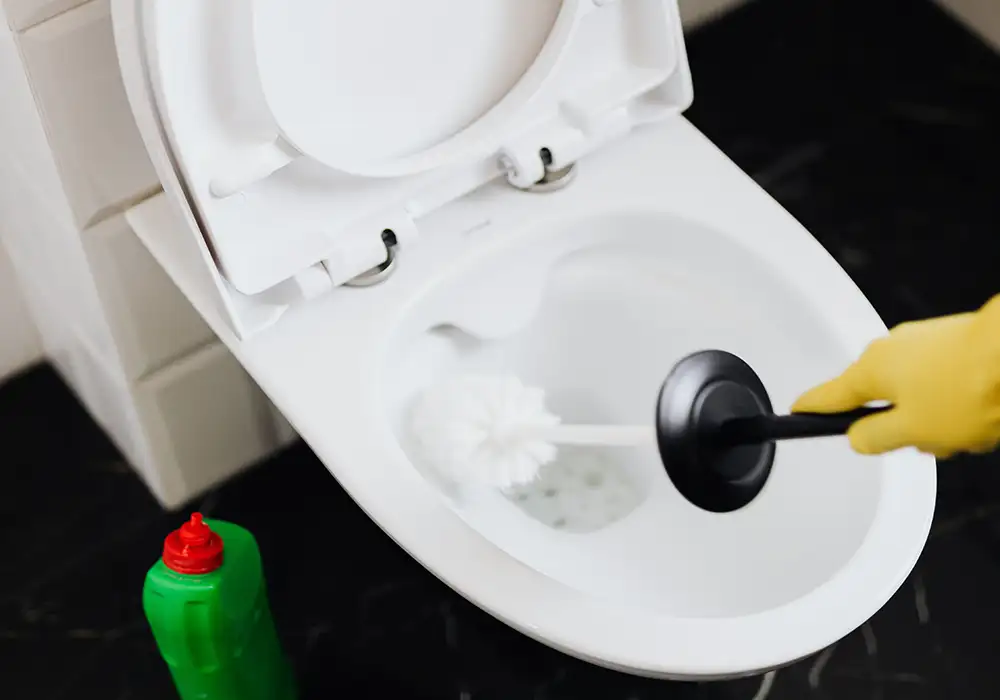
2. Use a toilet plunger
A proper toilet plunger is usually much more effective than a flat sink plunger.
Place the plunger over the toilet outlet so that it creates a good seal.
Then:
- Push down gently at first.
- Pull back firmly.
- Repeat the movement several times.
- Keep the seal intact.
- Remove the plunger carefully.
- Wait and see whether the water level falls.
The aim is to create pressure and suction that moves the obstruction rather than simply forcing it deeper into the pipe.
Do not use excessive force.
If the toilet is completely full, take care to avoid splashing contaminated water.
3. Try warm water and washing-up liquid
For a minor blockage caused by paper or waste, warm water and a small amount of washing-up liquid may help lubricate the obstruction.
Add a reasonable amount of washing-up liquid to the bowl.
Then add warm, not boiling, water.
Leave it for several minutes before trying the toilet again.
Do not use boiling water.
Very hot water can potentially damage or stress some toilet components, seals or ceramic.
This method is more useful for soft blockages than for solid objects.
4. Try a toilet auger
If plunging does not work, a toilet auger can sometimes reach further into the trap and break up or retrieve an obstruction.
A toilet auger is designed specifically for toilets and is less likely to damage the ceramic than improvised metal objects.
Use it carefully and follow the manufacturer’s instructions.
If you meet a solid obstruction that will not move, stop rather than repeatedly forcing the tool.
What you should NOT put down a blocked toilet
Some DIY attempts can turn a relatively simple blockage into a much bigger problem.
Avoid putting the following down the toilet:
- Wet wipes, even where labelled flushable
- Kitchen roll
- Paper towels
- Sanitary products
- Cotton buds
- Nappies
- Food waste
- Grease or oils
- Household objects
Toilets and drainage systems are designed for specific materials.
The fact that something is small enough to disappear through the toilet does not mean it will travel safely through the drainage system.
Should you use drain unblocker on a blocked toilet?
Generally, do not make chemical drain unblocker your first choice for a blocked toilet.
Strong drain chemicals can create several problems.
They may:
- Fail to dissolve the actual obstruction
- Damage certain plumbing components
- Create hazardous fumes
- Leave dangerous chemicals in the toilet bowl
- Cause burns if the water splashes during further attempts
- Create a hazard for the plumber who later has to work on the blockage
Mechanical methods such as plunging or a suitable toilet auger are normally preferable for a straightforward toilet blockage.
If you have already used a chemical product, tell the plumber before they begin work.
What if the toilet is still blocked after plunging?
If a proper plunger has not cleared the blockage after several attempts, don’t keep forcing it.
The obstruction could be:
- Further along the waste pipe
- A solid foreign object
- A heavily compacted blockage
- A damaged pipe
- Part of a larger drainage problem
At this point, professional diagnosis becomes more sensible.
A plumber can determine whether the problem is confined to the toilet or connected to the wider drainage system.
Why does my toilet keep blocking?
A toilet that repeatedly blocks deserves more attention than a one-off blockage.
Possible reasons include:
The original blockage was not completely removed
Water may flow again but the pipe can still be partially restricted.
Too much paper is being flushed
Large quantities of toilet paper can contribute to recurring blockages, particularly where the drainage system is already restricted.
Something unsuitable is being flushed
Wet wipes and sanitary products are common contributors to drainage problems.
The drainage pipe is restricted
Limescale, deposits or another obstruction can reduce the available flow.
There is a problem with the external drain
If several fixtures are affected, the restriction may be outside the toilet itself.
Repeated blockages are a reason to investigate the underlying cause rather than repeatedly treating the symptom.
What if the toilet and sink are both blocked?
This is an important clue.
If flushing the toilet causes water to rise in the bath or shower, or if the basin and toilet are both draining slowly, the problem may not be inside the toilet.
It could indicate a restriction in the shared waste or drainage pipe.
In that situation, repeatedly plunging the toilet may not solve the underlying problem.
A plumber or drainage specialist may need to inspect the system.
What if sewage is coming back into the toilet?
Sewage backing up is a more serious situation.
Do not continue flushing.
Avoid unnecessary contact with contaminated water and keep children and pets away from the affected area.
If the backup is affecting multiple fixtures, there may be a significant blockage in the drainage system.
Professional assistance should be arranged promptly.
Blocked toilet in a London flat
Blocked toilets in flats can sometimes be more complicated because the waste system may connect to communal drainage.
If other flats are experiencing similar problems, the blockage could potentially be within a shared drainage system.
Before arranging extensive private work, check whether the building management or landlord needs to be notified.
If the problem is isolated to your toilet and other residents have no issues, an internal blockage is more likely.
When is a blocked toilet a plumbing emergency?
Not every blocked toilet requires an emergency plumber.
A minor blockage that is contained inside the toilet can often wait for normal plumbing assistance if DIY methods have failed.
However, seek urgent help if:
- The toilet is overflowing
- Sewage is backing up
- Multiple drains are affected
- Wastewater is entering the property
- You cannot isolate the water supply
- A pipe has burst
- The blockage is causing significant water damage
- The property has only one toilet and it cannot be used
The priority is to prevent contaminated water or sewage from spreading through the property.
How much does it cost to unblock a toilet in London?
The cost depends heavily on the cause and the amount of work required.
A straightforward local blockage may be relatively simple to clear.
More complicated problems can involve:
- Drain cleaning
- Specialist equipment
- CCTV drain inspection
- Removal of a foreign object
- Repair of damaged pipework
- Access to external drainage
- Work on shared drainage systems
Rather than choosing a repair based purely on price, establish what is actually causing the blockage first.
A cheap attempt that fails repeatedly can ultimately cost more than diagnosing the problem properly.
How to prevent blocked toilets
Prevention is usually much easier than dealing with an overflowing toilet.
Flush only suitable waste
The toilet should generally be used for human waste and toilet paper.
Avoid flushing wipes
Even products marketed as flushable can contribute to drainage problems.
Keep objects away from the toilet
Small children can accidentally drop toys and other objects into the bowl.
Don’t flush excessive amounts of paper
If large amounts are unavoidable, consider whether they should be disposed of differently.
Pay attention to slow drainage
A toilet that regularly drains slowly may be warning you about a developing restriction.
Deal with recurring blockages
Repeated blockages are not normal and should be investigated.
A simple blocked toilet checklist
Before calling a plumber, check:
- Have I stopped flushing?
- Is the water level rising?
- Can I safely isolate the toilet’s water supply?
- Is only the toilet affected?
- Are the basin, bath or shower also draining slowly?
- Have I tried a proper toilet plunger?
- Have I avoided boiling water?
- Have I avoided strong chemical drain cleaners?
- Has the toilet blocked repeatedly?
- Is sewage backing up?
- Are neighbours or other flats affected?
These answers can help identify whether the problem is likely to be local or part of a larger drainage issue.
Need help with a blocked toilet in London?
If a plunger has not solved the problem, or your toilet keeps becoming blocked, the important thing is to identify why the blockage is happening.
Homacord provides plumbing services across London, including blocked toilets, drainage problems, leaks, plumbing repairs and emergency plumbing assistance.
The process is straightforward:
1. Contact us
Tell us what is happening and whether other drains are affected.
2. Assess the problem
We identify the likely location and cause of the blockage.
3. Explain the options
You will know what needs to be done before unnecessary work is carried out.
4. Clear or repair the problem
The appropriate plumbing or drainage method is used for the situation.
5. Check the system
The affected fixture is tested to make sure the problem has been properly addressed.
Need a plumber in London?
If your toilet is blocked, overflowing or repeatedly backing up, Homacord can help diagnose the problem and recommend the appropriate solution.
View Homacord Plumbing Services London
Frequently Asked Questions
What is the quickest way to unblock a toilet?
For a typical minor blockage, a suitable toilet plunger is usually the best place to start. Avoid repeatedly flushing the toilet if the water level is already high.
Can hot water unblock a toilet?
Warm water may help with some soft blockages, especially when combined with washing-up liquid. Avoid boiling water because it can potentially damage toilet components or ceramic.
Should I use drain cleaner in a toilet?
Strong chemical drain cleaners are generally not the first choice for toilet blockages. Mechanical methods such as a plunger or toilet auger are usually preferable.
Why does my toilet keep blocking?
Recurring blockages can be caused by excessive paper, unsuitable items being flushed, a partially restricted waste pipe or a larger drainage problem.
What should I do if my toilet is overflowing?
Stop flushing immediately. If possible, isolate the toilet’s water supply and keep people away from contaminated water. If the problem cannot be controlled, arrange professional plumbing assistance.
Why is my toilet blocked but the shower and sink work normally?
If only the toilet is affected, the blockage is more likely to be local to the toilet trap or its immediate waste pipe.
What does it mean if the toilet and bath are both blocked?
This can indicate a restriction further along a shared waste or drainage pipe rather than a blockage inside the toilet itself.
Are flushable wipes safe to flush?
Even products marketed as flushable can contribute to blockages and drainage problems. Water UK advises against flushing wipes, even those labelled as flushable, because they can contribute to sewer blockages. The safest approach is to dispose of wipes in household waste rather than flushing them.
When should I call an emergency plumber?
Call for urgent assistance when there is overflowing sewage, significant water damage, multiple affected drains, or another situation where the blockage cannot be safely contained.
Final takeaway
A blocked toilet does not always mean you need an emergency plumber.
Start by stopping the flushing, checking the water level and trying a suitable toilet plunger. For a minor blockage, this may be enough.
If the blockage does not clear, keeps returning, affects other fixtures or involves sewage backing up, the problem may be further into the drainage system.
The most important thing is not simply to clear the blockage, but to understand why it happened in the first place.
For blocked toilets, drainage problems and plumbing repairs across London, Homacord can help.