Boiler leaking water is not something to ignore.
Even a small drip can be caused by something relatively straightforward, such as a loose connection or damaged seal. But water leaking from a boiler can also indicate a more serious problem involving pressure, internal components or the heating system.
The important thing is to work out where the water is coming from and whether the leak is getting worse.
A boiler leak can also cause damage to flooring, cupboards and nearby electrical components, so it is worth dealing with the problem promptly. Vaillant recommends switching off the water supply and heating and contacting a qualified engineer when a boiler is leaking.
In this guide, we’ll explain where boiler leaks commonly come from, what different types of leaks can indicate and when you should call a heating engineer in London.
Is a Leaking Boiler Serious?
Yes, a leaking boiler should always be taken seriously.
That doesn’t necessarily mean the boiler needs replacing. Many leaks can be repaired once the cause has been identified.
However, continuing to use a leaking boiler without investigating the cause can allow water damage to develop and may cause further problems with the appliance.
Water can also come into contact with electrical components around the boiler.
Vaillant advises homeowners not to attempt to repair a leaking boiler themselves and recommends having the appliance inspected by a qualified Gas Safe registered engineer.
Where Can a Boiler Leak Water From?
The location of the water can provide an important clue.
Common sources include:
- Pipe connections
- Radiator valves
- The pressure relief valve
- The filling loop
- Seals and internal components
- Corroded pipework
- The heat exchanger
- Connections underneath the boiler
Not every leak actually originates inside the boiler itself.
Sometimes the water is coming from nearby pipework and simply appears to be coming from underneath the appliance.
Water Is Dripping From Underneath the Boiler
If you can see water dripping from underneath your boiler, don’t assume that the boiler itself is necessarily leaking internally.
The water could be coming from:
- A pipe connection
- A valve
- A seal
- The pressure relief system
- An internal component
- Nearby heating pipework
Baxi recommends checking the boiler and surrounding pipework for damp surfaces, dripping water, corrosion and other visible signs of a leak.
If you cannot clearly identify the source, don’t remove the boiler casing.
The casing should not be opened by an unqualified homeowner.
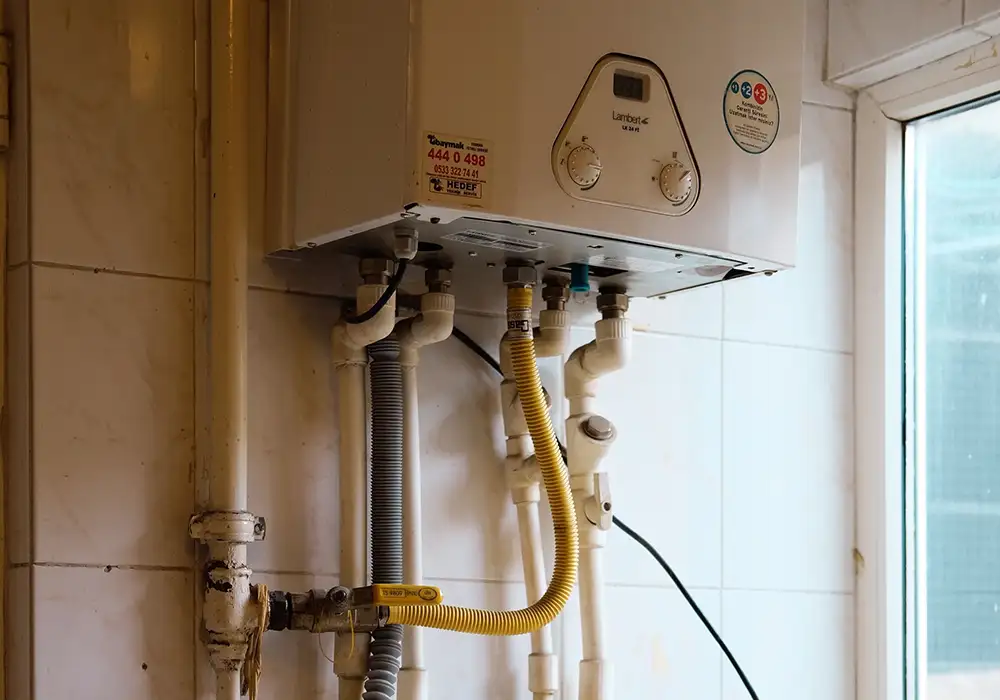
Water Leaking From a Pipe Under the Boiler
A visible pipe underneath the boiler can sometimes make it easier to identify where the water is coming from.
Look carefully at the connections and surrounding area.
A loose connection or damaged seal may allow water to escape.
However, don’t start tightening or dismantling boiler connections yourself.
If you’re unsure whether the pipe is part of the heating, hot-water, gas or condensate system, leave it alone and have it checked by a qualified professional.
A Leak From the Pressure Relief Valve
Another possible source of water is the pressure relief valve, sometimes called the PRV.
The pressure relief valve is designed to release water if the pressure in the heating system becomes too high.
If the valve is releasing water, you may notice water coming from a discharge pipe that leads from the boiler towards the outside of the property.
Vaillant’s guide to pressure relief valves explains how the valve releases excess pressure and where a discharge may appear.
A faulty or contaminated pressure relief valve can also cause ongoing water loss.
Baxi identifies debris inside the pressure relief valve as one possible reason for water discharge and low system pressure.
High Boiler Pressure Can Cause a Leak
Excessive pressure is another possible cause of boiler leaks.
In a sealed heating system, water expands as it heats.
The system therefore needs to accommodate changes in pressure.
If pressure becomes too high, the pressure relief valve can open and release water.
Vaillant explains that excessive boiler pressure can cause the pressure relief valve to release water from the system.
If you notice that the pressure rises significantly whenever the heating comes on and then falls again afterwards, the system may need professional investigation.
What Boiler Pressure Should Be?
The correct pressure depends on the boiler and heating system.
For many domestic systems, the pressure is commonly around 1 to 2 bar, although you should always check the manufacturer’s instructions for your specific boiler.
A pressure reading that is slightly different from the recommended range doesn’t automatically mean there is a major problem.
However, if the pressure is repeatedly rising too high or falling too low, there may be an underlying fault.
A Boiler Leak Can Cause Low Pressure
A leaking heating system can gradually lose water.
As water leaves the system, the boiler pressure can fall.
You may therefore notice two problems at the same time:
Water leak → water leaves the system → boiler pressure falls.
This is why a boiler that keeps losing pressure should not simply be topped up repeatedly.
Vaillant identifies leaks from radiators, valves and other heating-system components as common causes of pressure loss.
Can a Small Boiler Leak Get Worse?
Yes.
A small drip doesn’t necessarily remain a small drip.
A worn seal, corroded pipe or faulty component can deteriorate over time.
The water can also cause secondary damage to:
- Flooring
- Cabinets
- Walls
- Skirting boards
- Electrical components
- Nearby furnishings
This is why it is better to investigate the source early rather than waiting for the leak to become obvious.
Corrosion Can Cause Boiler Leaks
Corrosion can affect heating pipes, radiators, tanks and other components over time.
As metal becomes weaker, a small crack or damaged section can eventually allow water to escape.
You may notice:
- Rust
- Brown staining
- Damp areas
- Flaking paint
- Water marks
- Corroded pipe connections
Baxi’s advice on identifying a leaking boiler recommends checking for high pressure, damp areas, dripping underneath the boiler and corrosion around the pipework.
What If the Leak Is Coming From Inside the Boiler?
An internal boiler leak requires professional attention.
Possible causes include:
- Damaged seals
- Corroded internal components
- A faulty heat exchanger
- Internal pipe connections
- Other component failures
A faulty heat exchanger can be particularly expensive to replace, especially on an older boiler.
Vaillant identifies faulty heat exchangers, damaged seals, corrosion and excessive pressure among the possible causes of boiler leaks.
Do not remove the boiler casing to try to locate the leak yourself.
What If Water Is Leaking From the Radiator?
Sometimes homeowners assume that water underneath a boiler must be coming from the boiler.
But the heating system includes radiators and pipework throughout the property.
A leaking radiator valve or connection can cause water to escape and eventually reduce boiler pressure.
Check around accessible radiators for:
- Dampness
- Rust
- Water staining
- Corrosion
- Wet flooring
- Dripping valves
Vaillant’s guide to boiler pressure loss explains that leaks around radiator valves and system components are common causes of pressure loss.
Can a Boiler Leak Without Leaving a Puddle?
Yes.
A small leak may not immediately produce an obvious puddle.
Water can evaporate from hot pipework, or a small amount may escape slowly from a connection.
This means you should also look for indirect signs such as:
- Rust
- Corrosion
- Discoloured paint
- Damp skirting boards
- Water stains
- Flaking wallpaper
- Repeated drops in boiler pressure
Baxi notes that water from a heating-system leak may evaporate because of the heat of the pipework before it becomes obvious.
What Should I Do If My Boiler Is Leaking Water?
If you discover water leaking from your boiler, the first priority is to prevent further damage.
If it is safe to do so:
- Turn off the boiler.
- Turn off the heating.
- Try to contain or wipe up accessible water.
- Keep water away from electrical equipment.
- Check the pressure gauge without opening the boiler.
- Arrange for a qualified heating engineer to inspect the system.
Vaillant specifically recommends turning off the water supply and heating system and contacting a Gas Safe registered engineer when a boiler is leaking.
If you’re unsure which valve controls the water supply, don’t start turning valves at random.
Should I Keep Using a Boiler That Is Leaking?
It is better not to continue using a leaking boiler until the cause has been assessed.
This is particularly important if:
- The leak is getting worse
- Water is reaching electrical components
- The boiler pressure is falling
- The boiler is displaying a fault code
- The boiler is making unusual noises
- You can see significant water coming from the appliance
A leaking boiler can cause electrical problems and water damage, so it should be treated as an issue requiring prompt attention.
Can I Fix a Leaking Boiler Myself?
You can carry out basic visual checks, but you should not attempt to repair the boiler itself.
Do not:
- Remove the boiler casing
- Open internal components
- Disconnect gas components
- Repair internal seals
- Work on the heat exchanger
- Modify safety devices
- Attempt to repair the pressure relief valve
These jobs require appropriate professional knowledge and qualifications.
If the leak is from the boiler itself, arrange for a qualified heating engineer to inspect it.
What If the Boiler Is Losing Pressure as Well?
A leaking boiler and falling pressure often go together.
If the system is losing water, the pressure can gradually fall.
You may notice:
- Boiler pressure dropping
- Radiators becoming colder
- Boiler shutting down
- A low-pressure fault code
- The need to repeatedly repressurise the system
Vaillant’s guide to repressurising a boiler explains that low pressure can be associated with water leaks and that continued pressure loss should be investigated.
If you repressurise the system and the pressure quickly falls again, don’t keep repeating the process.
There may be a significant leak or another fault that needs attention.
When Is a Boiler Leak an Emergency?
A boiler leak deserves prompt attention, but some situations require more urgency than others.
Contact a heating engineer promptly if:
- Water is continuously dripping
- The leak is getting worse
- Boiler pressure is falling rapidly
- Water is coming from inside the boiler
- Water is reaching electrical components
- The boiler has stopped working
- You suspect a pressure relief valve problem
If you smell gas or suspect a gas leak, this is a gas safety issue, not simply a water leak.
Do not attempt to investigate or repair the gas appliance yourself.
Boiler Leaking Water in Your London Home?
A leaking boiler doesn’t automatically mean you need a replacement.
The cause could be a pipe connection, pressure problem, damaged seal, corrosion or another component.
The most important thing is to identify where the water is coming from and prevent the problem from causing further damage.
If the leak is coming from the boiler itself or you cannot identify the source, professional diagnosis is the safest option.
Heating Services can be linked here to Homacord’s Heating page for boiler and central-heating assistance.
For wider property maintenance requirements, Homacord links naturally to the main Homacord website.
Frequently Asked Questions
Is a leaking boiler dangerous?
A leaking boiler can become a serious problem because water can damage the appliance and nearby electrical components. The cause should be investigated as soon as possible.
Why is my boiler leaking water underneath?
Water underneath a boiler can come from a pipe connection, valve, seal, pressure relief system or an internal component. The visible location of the water does not always identify its exact source.
Can high boiler pressure cause a leak?
Yes. Excessive system pressure can cause the pressure relief valve to release water. If the pressure repeatedly becomes too high, the underlying cause should be investigated.
Can a boiler leak cause low pressure?
Yes. If water escapes from the heating system, the system pressure can gradually fall.
Can I use my boiler if it is leaking?
It is better to stop using a leaking boiler until the cause has been assessed, particularly if water is reaching electrical components or the pressure is falling.
Can I repair a leaking boiler myself?
You should not open the boiler casing or attempt internal repairs yourself. Arrange for a suitably qualified heating engineer to inspect the appliance.
Why is my boiler leaking but the pressure is normal?
A small or recent leak may not have caused a noticeable pressure drop yet. The water could also be coming from a component or connection that does not immediately affect system pressure.
What if my boiler is leaking and losing pressure?
If the boiler is both leaking and losing pressure, avoid repeatedly topping it up. The system may have a leak or another fault that needs professional investigation.
How do I know if the pressure relief valve is leaking?
A pressure relief valve can discharge water through a pipe leading from the boiler towards the outside of the property. If you suspect the valve is releasing water, have the system checked by a qualified heating engineer.
Vaillant’s guide to pressure relief valves
When should I call a heating engineer?
Call a qualified heating engineer if you cannot identify the source of the leak, the boiler pressure keeps falling, the leak is getting worse or you suspect an internal boiler fault.