Low Water Pressure in Your House? Causes & Fixes | London
Low water pressure in a London home can make showers weak, taps slow and toilets take longer to refill. The cause could be a restricted valve, limescale, old pipework, a shared water supply or a problem with the mains supply.
The first step is to find out whether the problem affects your whole property or just one tap or shower.
- All taps are weak: Check the incoming supply and internal stop valve.
- Only one tap is affected: Check for a blocked aerator, cartridge or local restriction.
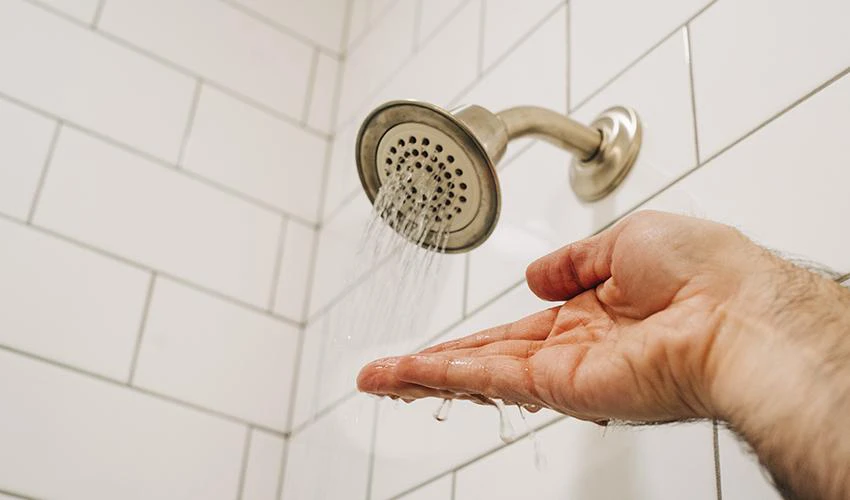
- Only the shower is weak: Check the showerhead, hose, valve and any shower pump.
- The problem affects neighbouring homes too: Contact Thames Water to check for a supply issue.
This guide explains how to check low water pressure safely, identify common causes and decide whether you need help from the water company or a plumber.
First: is it pressure or flow?
People often use “low water pressure” to describe any weak flow of water. Technically, pressure and flow are different things.
Pressure is the force that pushes water through the plumbing system. Flow rate is the amount of water that actually comes out of an outlet over a period of time.
A partially restricted pipe, valve or fixture can therefore leave you with reasonable pressure when the tap is closed but poor flow when water is running.
This is why a pressure reading alone does not always explain why a shower or tap feels weak.
How to check your water pressure at home
Before paying for a repair, there are several simple checks you can carry out.
Check the cold kitchen tap
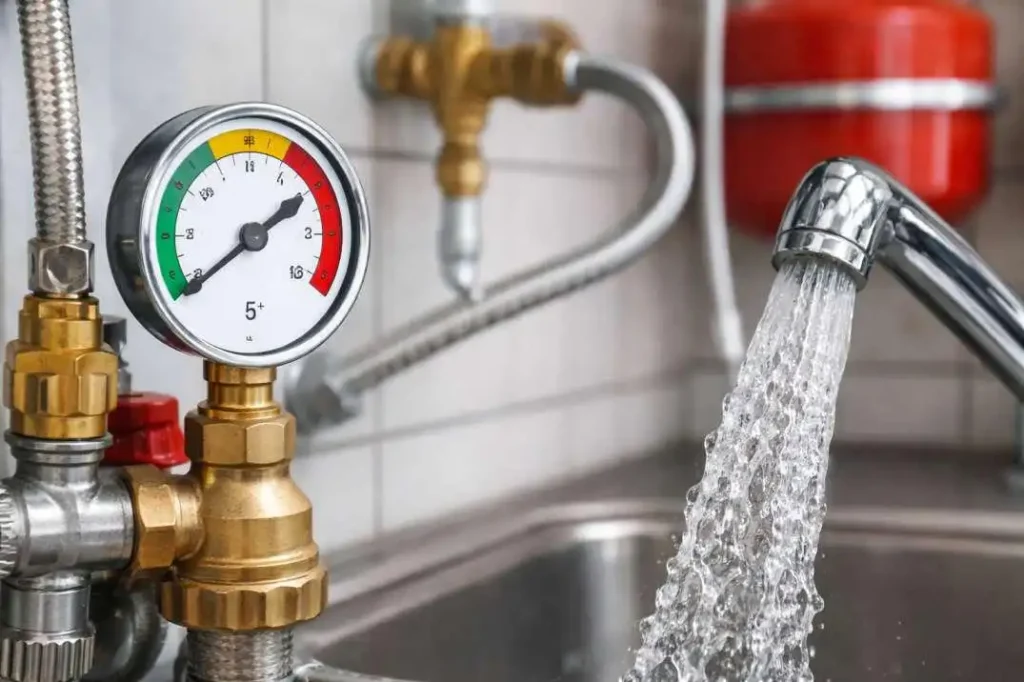
Start with the cold kitchen tap because it is normally connected directly to the incoming mains supply.
Turn off other taps and water-using appliances, then open the cold kitchen tap fully.
Ask yourself:
- Is the flow strong or weak?
- Does the flow start strongly and then fall away?
- Did the problem appear suddenly?
- Are other taps affected as well?
If the kitchen tap has good flow but the bathroom shower is weak, you probably do not have a whole-property mains pressure problem.
Thames Water also recommends using the cold kitchen tap as an initial check when investigating low or interrupted water supply.
Check your internal stop valve
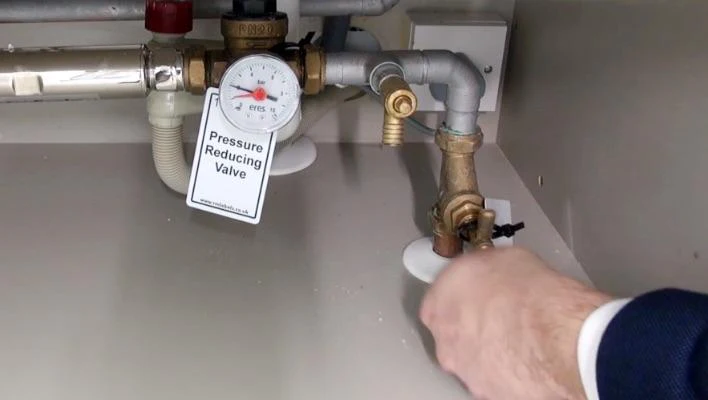
Your internal stop valve is often underneath the kitchen sink, although its exact location varies between properties.
It controls the incoming water supply to your home.
If it has been left partially closed after plumbing work, renovation or maintenance, it can restrict flow throughout the property.
If the valve is accessible and operates normally, make sure it is fully open by turning it gently anti-clockwise.
Do not force a seized valve. Old stop valves can leak or fail when excessive force is applied.
If the valve is difficult to operate, damaged or leaking, it is better to have it assessed by a qualified plumber.
Compare several taps
One of the most useful diagnostic checks is to compare different outlets around the property.
- Cold kitchen tap
- Bathroom basin tap
- Bath tap
- Shower
- Toilet cistern
- Outside tap, if available
If everything is weak, investigate the incoming supply, stop valve, PRV, supply pipe and network pressure.
If only the shower is weak, look at the showerhead, hose, cartridge and shower pump before blaming the mains supply.
If only one tap is affected, the tap aerator, cartridge or local isolation valve could be restricted.
If hot water is weak but cold water is normal, the problem may be related to the hot-water system rather than the incoming mains.
Measure the pressure properly
If you want a more meaningful measurement, a water pressure gauge can be connected to a suitable tap or test point.
However, pressure alone does not prove that the supply is healthy.
A system might show reasonable static pressure but experience a significant pressure drop when several outlets are used.
For a proper diagnosis, a plumber may need to consider static pressure, dynamic pressure, flow rate, pipe diameter, valve condition, supply arrangement, property height and whether the property shares a water supply.
Low Water Pressure London at Different Times of Day
If your shower is fine early in the morning but becomes weak around breakfast time or in the evening, that pattern is an important clue. Low water pressure London can sometimes be linked to higher demand on the local water network, particularly during busy morning and evening periods.
Water demand changes throughout the day. Morning routines, evening bathing and other periods of high consumption can reduce available pressure in some areas.
Ofwat identifies high demand as one factor that can contribute to reduced water pressure.
Keep a simple record of when the problem occurs.
| Time | Kitchen tap | Shower |
| 6:00am | Strong | Strong |
| 8:00am | Moderate | Weak |
| 1:00pm | Strong | Moderate |
| 7:00pm | Moderate | Weak |
A pattern like this can be much more useful to a plumber or water company than simply saying that the pressure is “bad”.
Common causes of low water pressure in London
1. A partly closed stop valve
A partly closed stop valve is one of the simplest things to check.
A valve may have been partially closed following plumbing repairs, leak repairs, kitchen renovations, boiler work or previous maintenance.
Because the valve controls the incoming supply, a restriction here can affect multiple outlets.
Check the valve without forcing it. If it is seized, damaged or leaking, professional attention may be needed.
2. A faulty pressure-reducing valve
Some properties have a pressure-reducing valve, commonly called a PRV, fitted to control incoming water pressure.
If the PRV becomes faulty, blocked or incorrectly adjusted, the pressure delivered to the property’s internal plumbing can become too low.
Typical signs include consistently poor pressure throughout the property, multiple taps being affected and a problem that does not change significantly during the day.
A PRV should be tested before simply replacing it.
3. Limescale and restricted pipework
London has hard water, and mineral deposits can accumulate inside plumbing components and pipework.
The most obvious places to see scale are often tap aerators, showerheads, shower valves and appliance connections.
A restriction does not necessarily mean that an entire pipe is blocked. Even a reduction in the effective internal diameter can affect flow, particularly where older or smaller pipework is already installed.
If water flow has gradually become worse over several years rather than disappearing suddenly, restricted pipework becomes more plausible.
4. Old supply pipes and lead pipework
Older London properties deserve particular attention because some may still contain lead supply pipes or older internal plumbing.
Thames Water states that properties built before 1970 may have lead supply pipes or internal plumbing.
Lead pipework is not simply a low-pressure issue. It is also a water-quality consideration.
If you suspect that pipework contains lead, do not aggressively scrape, cut or disturb it yourself.
Thames Water provides information about lead pipe replacement and eligibility for its replacement scheme.
5. A shared water supply
Some older London properties share a supply pipe with neighbouring properties.
This can be particularly relevant in older terraces and converted properties.
You may suspect a shared supply if:
- Pressure falls when neighbouring properties are using large amounts of water.
- Your supply is noticeably weaker during peak periods.
- The outside stop valve arrangement is unusual.
- You cannot identify an independent supply.
- A neighbour experiences a similar pattern.
If a shared supply is restricting your property, changing the supply arrangement may be an option, although this can be a more involved project than repairing an internal valve or fitting a suitable pump.
6. Your property is too high for the available pressure
Water pressure is affected by height.
The higher an outlet is above the incoming supply, the more pressure is required to push water to it.
This can become particularly noticeable in top-floor flats, converted Victorian houses, multi-storey homes and loft bathrooms.
A shower upstairs may therefore feel much weaker than a kitchen tap downstairs.
7. A gravity-fed plumbing system
Some older properties use a cold-water storage tank, often located in the loft, with gravity providing pressure to certain outlets.
In a simple gravity-fed system, available pressure depends heavily on the vertical distance between the water level in the tank and the outlet.
A bathroom close to the storage tank may therefore have relatively low pressure.
In these properties, increasing mains pressure is not necessarily the correct solution.
Depending on the system, the answer could involve a suitable shower pump, changes to the plumbing arrangement, improved pipe sizing or replacement of restrictive components.
8. A problem on the Thames Water network
Sometimes the problem is not inside your property at all.
Low pressure can be associated with water-main work, bursts, network equipment problems, leakage or periods of unusually high demand.
Ofwat identifies inadequate pumping, undersized mains, leakage, equipment failures and blocked service pipes among possible causes of low pressure.
Thames Water recommends checking for known supply problems and asking neighbours whether they are experiencing the same issue.
What water pressure should you have in a London home?
There is an important difference between the minimum standard that applies to a water supply and the pressure that feels comfortable inside a modern home.
Ofwat’s Guaranteed Standards Scheme specifies a minimum pressure of 7 metres static head, approximately 0.7 bar, in the communication pipe serving supplied premises.
Thames Water states that it aims to provide a minimum of 10 metres static head, approximately 1 bar, at the point where its pipe responsibility ends.
This is why saying that “anything below 1 bar is illegal” is too simplistic.
The applicable standard depends on where the pressure is measured, the circumstances of the supply and the relevant water-company commitments.
What should you do if Thames Water is responsible?
If your checks suggest that the problem is outside your property:
- Check Thames Water’s current supply information for your postcode.
- Ask neighbours whether they have the same problem.
- Record when the pressure falls.
- Check the cold kitchen tap.
- Report the issue to Thames Water.
- Ask them to investigate the pressure and flow at the appropriate point in the supply.
What if the mains pressure is adequate but your home still has weak flow?
This is where professional plumbing diagnosis can save you from spending money on the wrong repair.
A plumber can work backwards from the incoming supply and identify where the restriction occurs.
The inspection may include:
- Incoming pressure and flow
- Stop valve
- Pressure-reducing valve
- Supply pipe
- Shared supply arrangement
- Internal pipework
- Individual taps and fixtures
- Shower components
The aim is to identify the actual restriction before recommending a repair or improvement.
Low shower pressure but normal taps? Start here.
If your kitchen and basin taps have good flow but your shower is weak, the mains supply is unlikely to be the first thing to investigate.
Check the showerhead
Limescale can restrict the small openings in a showerhead and reduce the amount of water passing through it.
Clean or replace the showerhead according to the manufacturer’s instructions.
Check the shower hose
A damaged, kinked or internally restricted hose can reduce flow.
Check the thermostatic cartridge
A partially blocked or failing cartridge can restrict water passing through a thermostatic shower valve.
Check the shower pump
If your property uses a pumped gravity-fed shower system, a failing pump can cause gradually deteriorating performance.
If cleaning the showerhead does not make a meaningful difference, the shower valve, pump and supply arrangement may need professional inspection.
Should you install a water pressure booster pump?
Sometimes, but a booster pump is not a universal cure for low water pressure.
A pump may be appropriate where the property’s plumbing system is designed for pumped assistance and the incoming supply is suitable.
It may not be appropriate if:
- The actual problem is a blocked pipe.
- A stop valve is partly closed.
- A PRV is faulty.
- There is a leak.
- The supply arrangement needs changing.
- The existing plumbing system is unsuitable for the proposed pump.
The sensible sequence is:
Diagnose → identify the restriction → choose the appropriate solution.
Not:
Low pressure → immediately buy a pump.
When should you call a London plumber?
Professional help is worth considering if:
- Pressure is low throughout the property.
- The problem is getting progressively worse.
- The stop valve is seized or leaking.
- You suspect a PRV fault.
- You suspect restricted or old supply pipework.
- A shower pump is failing.
- You suspect a hidden leak.
- Your property has an unusual shared supply.
- You are considering replacing lead pipework.
- You need a pump or pressure-boosting solution.
- Thames Water has confirmed that its network pressure is adequate.
Can a leak cause low water pressure?
Yes. A significant leak can affect available flow and may produce symptoms such as:
- Pressure dropping when several outlets are used.
- Unexpectedly running water.
- Damp areas.
- Water movement sounds inside walls, floors or cupboards.
- Unexplained changes in water consumption.
If you suspect a hidden leak, do not simply compensate for weak pressure by installing a pump.
The leak should be investigated first.
Low water pressure in a London flat
Flats can present different pressure problems from houses.
Your water flow may be affected by:
- Floor level
- Shared building pipework
- Communal booster systems
- Storage tanks
- Pressure-reducing equipment
- Building management systems
- Shared supply arrangements
If several residents in the same building have suddenly experienced the same pressure problem, speak to building management or the relevant water company before arranging private plumbing work.
If the problem affects only your flat, an internal plumbing fault becomes more likely.
Why older London homes need extra investigation
London has a huge variety of property types, from modern apartments to Victorian terraces and converted houses.
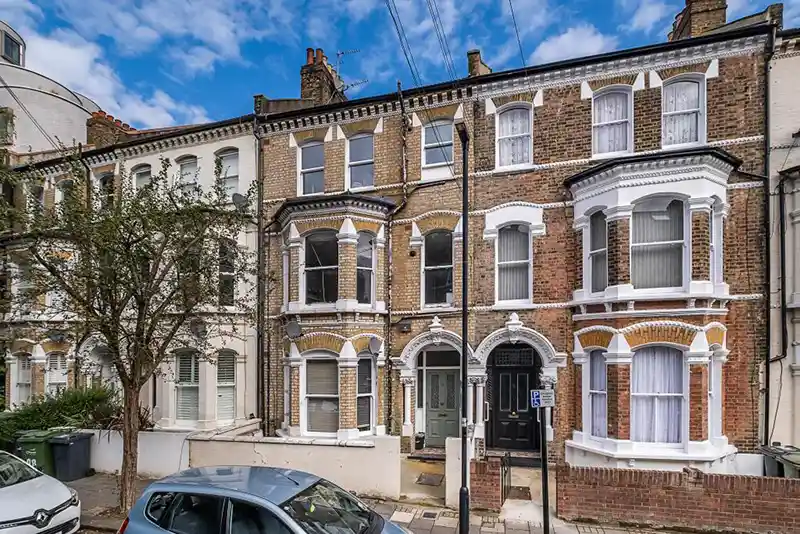
Two properties on the same street can therefore have completely different plumbing arrangements.
An older property may contain:
- Older supply pipework
- Shared water connections
- Multiple generations of plumbing
- Gravity-fed storage
- Older valves
- Lead components
- Narrower pipework
- Later extensions with different plumbing configurations
This is why the age of the property or postcode alone cannot tell you exactly what is causing low water pressure.
The actual plumbing arrangement needs to be checked.
What not to do when water pressure is low
Don’t immediately buy a booster pump
You could be treating the symptom rather than the cause.
Don’t force an old stop valve
You may turn a pressure problem into a leak.
Don’t cut or disturb suspected lead pipework
Lead pipework requires appropriate handling and replacement planning.
Don’t assume Thames Water is always responsible
The problem may be inside your property.
Don’t assume the problem is always inside your property
If neighbours are affected too, the water network should be investigated.
Low water pressure checklist
- Is the cold kitchen tap weak?
- Are all taps affected?
- Is the problem only on hot water?
- Is the shower the only weak outlet?
- Did the problem start suddenly?
- Does it become worse at peak times?
- Have my neighbours noticed the same problem?
- Is the internal stop valve fully open?
- Is there evidence of a leak?
- Is the property a flat or top-floor property?
- Does the property have a loft tank or gravity-fed system?
- Could the supply be shared?
- Is the property old enough to contain lead pipework?
Need help diagnosing low water pressure in London?
If you’ve checked the obvious causes and your water flow is still poor, the next step is to identify where the restriction is occurring.
Homacord provides plumbing services across London, including plumbing repairs, leak detection, blocked drains, installations and low-water-pressure diagnosis.
Our approach is straightforward:
- Contact us and explain what has changed and which outlets are affected.
- We assess the plumbing system and likely source of the restriction.
- We explain the problem and the available options.
- Where appropriate, we carry out the required plumbing work.
- We check the system after the work has been completed.
If your taps are weak, your shower has lost flow, or you cannot determine whether the problem is inside your property or on the water network, Homacord can help identify the likely cause and recommend the appropriate solution.
Frequently Asked Questions
What causes low water pressure in a house?
Common causes include a partly closed stop valve, restricted pipework, a faulty PRV, shared supply pipes, leaks, property height, gravity-fed systems and problems affecting the public water network.
Why is my shower pressure suddenly low?
If other taps remain strong, check the showerhead, hose, thermostatic cartridge and any shower pump before investigating the mains supply.
Is 1 bar enough water pressure for a home?
Around 1 bar can be a useful reference point, but whether it provides satisfactory performance depends on the property, outlet height, pipework, appliances and demand. Thames Water refers to 10 metres static head, approximately 1 bar, in its customer commitment, while Ofwat’s guaranteed minimum standard is 7 metres static head, approximately 0.7 bar.
Can Thames Water fix low water pressure?
If the cause is within the water company’s network or its responsibility, Thames Water can investigate the supply. If the problem appears to be inside your property, internal plumbing should be investigated.
Can an old London property have lead water pipes?
Yes. Thames Water states that properties built before 1970 may have lead supply pipes or internal plumbing.
Should I install a water pump?
Only after the plumbing system has been assessed. A pump can be appropriate for some systems, but it will not correct every cause of low pressure.
Why does my water pressure drop in the morning?
High demand can reduce available pressure, and shared supplies can make the effect more noticeable. If your pressure is consistently worse during peak periods, record the times and compare your experience with neighbouring properties.
Can limescale reduce water flow?
Yes. Limescale can restrict small openings and components such as showerheads and tap aerators. In older plumbing systems, accumulated deposits can also contribute to restricted flow.
Should I call a plumber or Thames Water?
If neighbours are experiencing the same issue, check the water company’s network information and report the problem to them. If the problem appears to be limited to your property, investigate the internal plumbing or contact a plumber.
Final takeaway
Low water pressure is not always a plumbing emergency, but it is worth diagnosing properly.
Start with the simple checks: cold kitchen tap, stop valve, comparison between outlets, neighbouring properties and the timing of the problem.
If Thames Water’s supply is the problem, reporting it to the water company is the appropriate route.
If the incoming supply is adequate but your home still has poor flow, the restriction may be somewhere inside the property — from a valve or PRV to old pipework, a shared supply, a shower component or a gravity-fed system.
If you are unsure where the problem is coming from, a proper plumbing diagnosis can save you from spending money on the wrong solution.
For London plumbing repairs and low-water-pressure diagnosis, visit Homacord Plumbing Services.